

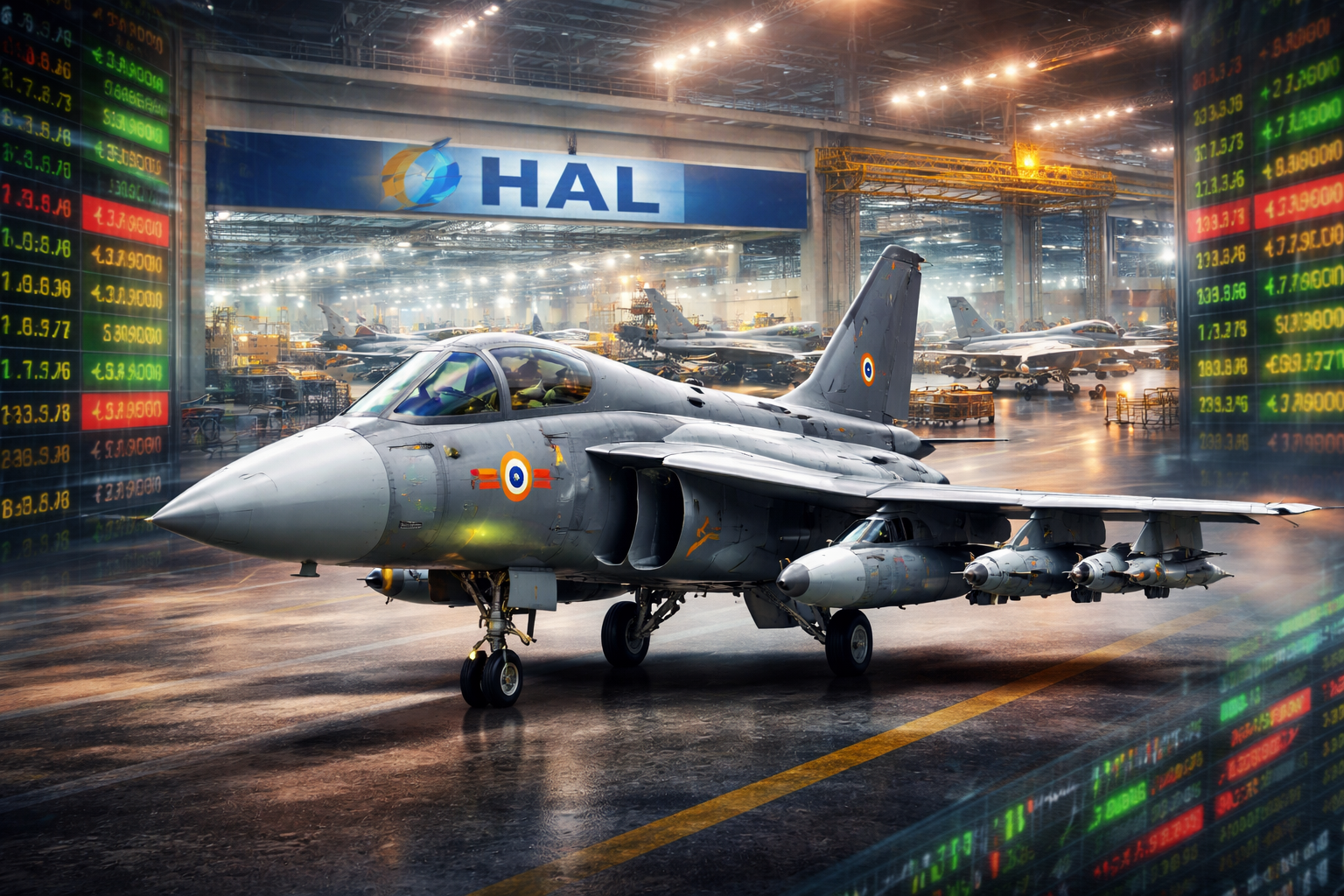

When news broke that the Indian Air Force had grounded its entire fleet of Tejas light combat aircraft, traders did not wait for a detailed official briefing. HAL Shares After Tejas Grounding slipped more than 3% on the BSE, closing near Rs 4,030, instantly making the stock one of the biggest laggards on the Nifty India Defence index.
The incident itself stemmed from a February 7 runway overshoot at a frontline air base, reportedly due to a suspected brake failure. While the pilot ejected safely and escaped without serious injury, the aircraft suffered significant airframe damage. What followed was not just a technical review—but a market reaction that has reopened debates about India’s indigenous defence ambitions.
Inside the Incident That Sparked the HAL Shares After Tejas Grounding Selloff
The story behind HAL Shares After Tejas Grounding began with what officials described as a routine training sortie gone wrong. According to PTI, the Tejas jet overshot the runway while returning to base, triggering immediate operational and financial ripples.
IAF’s Decision to Ground the Entire Tejas Fleet
The Indian Air Force grounded its entire fleet of roughly 30 single-seat Tejas aircraft for a comprehensive technical review.
This move signals procedural caution rather than panic. Grounding an entire fleet is standard protocol when systemic risks are suspected. In this case, the IAF ordered inspections of undercarriage metallurgy, the electromagnetic braking system, and onboard software, reflecting concerns about both mechanical and digital integrity.
Third Tejas Loss Since Induction
This marks the third Tejas aircraft loss since induction.
The first crash occurred near Jaisalmer in March 2024. The second tragic incident happened during an aerobatic display at the Dubai Airshow in November 2025, where Wing Commander Namansh Syal lost his life. Each incident adds weight to investor anxiety, even if statistically the safety record remains strong.
Court of Inquiry Underway
A Court of Inquiry has been initiated to determine the exact cause of the runway overshoot.
Such inquiries typically assess pilot input, mechanical systems, weather conditions, and maintenance logs. Until the findings are public, speculation will likely continue influencing HAL Shares After Tejas Grounding and broader aerospace stocks.
HAL’s Official Response: Damage Control or Confidence?
As HAL Shares After Tejas Grounding dominated financial headlines, Hindustan Aeronautics Limited issued a filing clarifying that there had been “no reported crash” and labeled the event a “minor technical incident on ground.”
HAL emphasized that the Tejas platform maintains one of the world’s best safety records among contemporary fighter aircraft. That statement aims to anchor investor confidence, especially when sentiment can swing on incomplete narratives.
HAL Shares After Tejas Grounding and Market Sentiment
The immediate drop in HAL Shares After Tejas Grounding appears largely sentiment-driven.
Putta Ravi Kumar, defence analyst at Choice Institutional Equities, told the Economic Times that a single operational incident does not alter structural demand outlook or order visibility. In other words, long-term fundamentals may remain intact despite short-term volatility.
Morgan Stanley’s Underweight Call
Earlier this month, Morgan Stanley downgraded HAL to “underweight” and cut its price target by 34% to Rs 3,355.
The brokerage cited execution risks and rising private-sector competition. The Tejas grounding news simply amplified existing investor caution. When downgrade meets disruption, the market reaction often doubles in intensity.
The Bigger Backdrop: Delays, Engines, and Competitive Pressure
The HAL Shares After Tejas Grounding story cannot be isolated from ongoing challenges in the Tejas Mk1A program. Deliveries are running nearly two years behind schedule.
The delay largely stems from a shortfall in F404 engine deliveries from GE Aerospace. Without engines, aircraft assembly lines slow down. And when timelines slip in defence contracts, investor patience thins quickly.
Tejas Mk1A Program Running Behind Schedule
The Tejas Mk1A is central to India’s modernization push.
Any delay impacts squadron planning, budget allocations, and export prospects. Analysts have warned that prolonged execution issues could create space for private aerospace players entering India’s defence ecosystem.
Dependence on GE Aerospace Engines
The reliance on GE Aerospace’s F404 engines has become a bottleneck.
Global supply chain disruptions and production constraints have affected deliveries. This highlights a broader vulnerability in India’s defence manufacturing ambitions—self-reliance in design does not automatically translate into full supply chain independence.
Defence Sector Growth Still Strong
Despite the HAL Shares After Tejas Grounding dip, India’s defence sector fundamentals remain robust.
India’s defence production crossed Rs 1 lakh crore for the first time in 2023, reflecting a strong upward trajectory. This suggests the broader defence ecosystem may weather isolated operational setbacks.
Global Fighter Jet Safety Context
Globally, fighter jet programs often face early-stage incidents.
A RAND Corporation study on combat aircraft programs notes that most new-generation fighter programs experience multiple operational incidents before stabilizing performance metrics. Investors familiar with aerospace cycles may see HAL Shares After Tejas Grounding as part of that broader pattern.
What Investors Should Watch Next
The future of HAL Shares After Tejas Grounding will hinge on transparency, timelines, and technical findings.
Investors are closely tracking the outcome of the Court of Inquiry, updates on GE engine deliveries, and revised delivery schedules for the Tejas Mk1A. Any positive clarity could trigger a rebound in defence stocks.
Operational Clarity from IAF
An official statement from the IAF would likely calm market nerves.
Markets dislike ambiguity more than bad news. Clear communication often stabilizes stocks faster than optimistic projections.
Engine Delivery Milestones
Updates from GE Aerospace regarding F404 engine shipments could influence sentiment significantly.
A confirmed acceleration in deliveries would address one of the core execution risks flagged by analysts.
Order Book Strength
HAL’s order book visibility remains strong.
Large defence contracts typically span years, providing revenue cushioning against isolated incidents. Analysts argue that this structural demand remains unaffected by the HAL Shares After Tejas Grounding episode.
Investor Psychology and Defence Stocks
Defence stocks often move on headlines.
Unlike FMCG or IT, aerospace is closely tied to national security narratives. A single incident can swing sentiment sharply—even if long-term projections stay intact.
Conclusion: Beyond the Headlines of HAL Shares After Tejas Grounding
The fall in HAL Shares After Tejas Grounding reflects a classic market reaction—swift, emotional, and driven by uncertainty. Yet beneath the surface lies a more layered reality. The IAF’s fleet grounding demonstrates procedural caution, not systemic collapse. HAL’s safety record claim, ongoing inquiries, and structural defence demand all point to a more nuanced picture.
For investors, the key lies in separating operational incidents from strategic trajectory. India’s defence production has been scaling rapidly, and Tejas remains a flagship indigenous program. If engine supply stabilizes and the technical review clears systemic flaws, HAL Shares After Tejas Grounding could become a temporary dip in a long-term growth narrative rather than a turning point.
Keep your eyes on Trending Eyes for real-time insights and analysis.