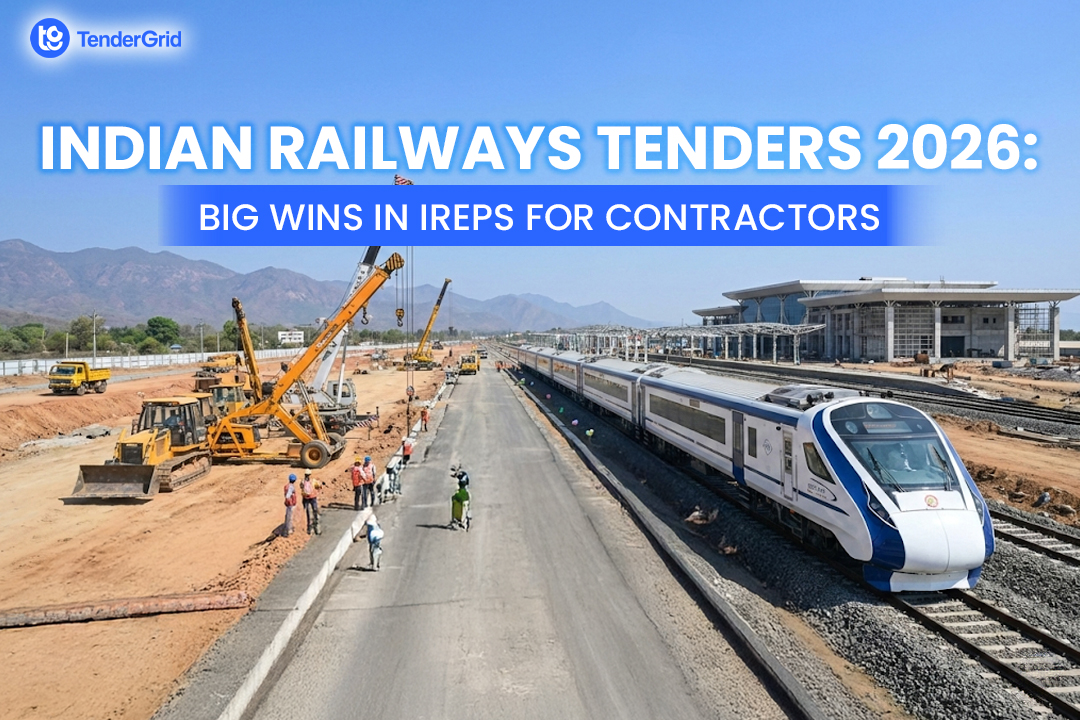
Indian Railways has always been more than simply a transportation service in the country, the rail network is an engine of economic growth that keeps India on its feet. With the country accelerating towards growth through infrastructure development, Indian Railways Tenders 2026 are emerging to be some of the most ambitious in quite some time. Whether it involves the reconstruction of railway station and railway line doubling projects, railway electrification projects, renovation of railway signaling systems, or the manufacturing of railway transport vehicles, there is a big potential in future contracts, and the trick is in knowing where to look.
At the heart of this tendering exercise is the IREPS. This acronym actually stands for the Indian Railways E-procurement System. Opportunities are available for contractors who are up for the challenge, as the IREPS Tenders of 2026 may reward them with very lucrative contracts from the Railways.
Why 2026 Is a Breakout Year for Railway Contracts
Modernisation is transforming the Indian Railways sector for good. The new schemes are aligned towards goals with national priorities such as Make in India, Gati Shakti, and net-zero targets. This means tenders are not limited to traditional civil works anymore. Contractors can expect diversified requirements across:
- Infrastructure expansion and gauge conversion
- Electrification and renewable energy integration
- Advanced signalling systems like Kavach
- Station redevelopment under PPP models
- Manufacturing and maintenance of rolling stock
- Digital solutions for operations and passenger services
What makes Indian Railways Tenders particularly attractive is their scale and continuity. Unlike one-off government projects, railway contracts often span multiple years, phases, and zones, creating repeat business for reliable vendors.
IREPS: Where Opportunities Take Shape
IREPS (Indian Railways E-Procurement System) has become a single window system providing access to tenders of the Railways zones, production units, as well as its PSUs. By 2026, the system will handle an even more massive number of tenders with more transparency.
For contractors, this means:
- Faster tender discovery across multiple railway divisions
- Reduced paperwork and clearer eligibility criteria
- Real-time updates on corrigenda, bid submissions, and results
- Equal opportunity access for MSMEs and regional players
However, the real challenge is not availability, it is visibility. Hundreds of IREPS Tenders are floated regularly, and missing the right one can mean losing a major business opportunity.
High-Potential Tender Categories to Watch in 2026
Contractors seeking lucrative wins need to monitor closely the following rapidly growing markets under the contracts of the railways:
1. Civil & Infrastructure Works
Projects in new lines, bridges, yards, and upgrade contracts in stations are still leading Indian Railways Tenders. The renovation of major stations into international-standard transportation hubs is likely to give rise to vast opportunities in the EPC and subcontracting sectors.
2. Electrification & Power Systems
With Indian Railways pursuing the route of 100% electrification, there is an increasing number of tenders for OHE jobs, traction substations, and energy-efficient systems. Experienced contractors in power infrastructure are in high demand in this sector.
3. Signalling & Safety Projects
Safety-related projects such as automatic signaling, train protection systems, and telecommunication upgradation are seeing niche contracting companies. Such tenders usually have stringent technical specifications, though also with increased margins.
4. Manufacturing & Supply Contracts
IREPS involves much more than construction work. IREPS is far beyond construction work. Procuring of components, spares, machinery, and parts of rolling stock is one of the key areas where Railways enter into contracts and open wide avenue for the manufacturers and suppliers in many ways.
What Successful Contractors Are Doing Differently
Winning Indian Railways Tenders in 2026 will require more than competitive pricing. Contractors who consistently secure IREPS tenders focus on:
- Pre-qualification readiness, including certifications and past performance
- Zone-wise tender tracking instead of random searches
- Timely analysis of BOQs, technical specs, and eligibility clauses
- Strategic joint ventures for large-value railway contracts
- Proactive compliance with evolving procurement norms
In a crowded bidding environment, preparation and information access make all the difference.
How Tender Grid Simplifies Railway Tendering
The world of IREPS Tenders is enormous, and it may be difficult for contractors dealing with various sectors. Here is where the role of Tender Grid becomes very important.
Tender Grid compiles Indian Railways Tenders from the IREPS tender website and other government sources into a single dashboard. Contractors are able to filter Indian Railways Tenders by zone, category, budget, and deadline. This allows contractors to never miss an Indian Railways Tender again. By using the services of Tender Grid, contractors are able to move away from Indian Railways Tender-reactive planning.
Rather than wasting time searching for opportunities on portals, contractors can now concentrate on what really counts, improving bids and securing more contracts with the Railways.
To Summarise
Indian Railways Tenders 2026 are not just short-term projects, but are instead gateways to growth, credibility, and operations at the national level. As infrastructure spending goes up and IREPS-Simplification gets easier, contractors who are informed and organised will really stand out.
The distinction between involvement and success is actually the difference in the effective realisation of opportunities. If the right preparation is done, the upcoming year could be the definitive era for the contracting community that wants the railways of India to take shape one tender at a time.